Baladi
Door Lana Bastašić
In the morning, we walk through the empty park. No couples, no children’s birthdays, no yoga groups or tightrope walkers. Just us. In less than an hour, the park will be full of other souls, both dog and human. There will be chatter, barking, the smell of beer and marijuana, and some music. But for now, the park is ours, and there is silence.
We aren’t really alone, though. There are blackbirds hopping on the grass and four or five rabbits emboldened by the quiet of the early morning. There is a hard-working brown squirrel with a white belly. It seems entirely undisturbed by our presence. The dog pulls at the leash—her deep instincts triggered by the fluffy rodent. I kneel by my companion and press my warm palm against her golden fur. It’s okay, I whisper. She’s just looking for some food. We won’t bother her. And so we stay there, quiet, and watch the squirrel as it crosses our path repeatedly, back and forth, carrying hazelnuts in its perfect little hand-like paws.
The dog seems to miss her real owner. Sometimes she lies in the kitchen, unmoved by Charlie Parker, watching me cook, and there is a deep sense of mourning in her brown eyes. This breaks me. I stop whatever it is I’m doing and lie next to the dog. I rub her belly and kiss her warm snout. She’s coming back, I tell her. She loves you, and she’s coming back as soon as the conference is over. But dogs have a different sense of time. She knows when we walk and when we eat dinner, but other than that, she exists in an endless now. The duration of an archaeology conference is no clearer to her than it is to me. So she suffers what she needs to suffer, and I’m there to help her through it. It reminds me how all suffering is tied to the way we perceive time—the passing of it, the inescapability of it. How it can move both fast and slowly, and fill our existence with too much or too little. The dog cannot ponder these thoughts, but she feels them. She feels Time more than we do.
We walk all the way to Tiergarten, and I tell her how, once, this was a hunting ground full of wild animals. I tell her how kings have come and gone, expanding the park, adding bridges to it, changing it. I tell her how the Nazis moved the Victory Column, how people buried statues in the ground so bombs wouldn’t destroy them, how the British cut the trees because they needed coal and used the land to grow potatoes. And what do her eyes tell of in return? Perhaps of Egypt, of the desert, and how endless it is when you are a thirsty Baladi dog, forsaken by humans, flea-ridden and hungry. What it must feel like to be carved into stone or drawn on a wall 3,000 years before Christ, her pricked ears and tightly curled tail immortalized next to rare gods. Only to starve. Only to be hunted down and killed. Perhaps she would tell me of the moment a young Polish Egyptologist looked up from her tools and saw an old soul materialize from the sand. How she bit this human gently on the ankle, the way love bites whenever it begins. It says, I am here. It says, Help me stay a little longer. But stories are a thing of humans, so she stays quiet. The frailty of our language will not do.
We take a break in Savignyplatz at Zwiebelfisch, my favorite bar. I order a big glass of Apfelschorle, and she gets a treat and a bowl of water. People smile at us. They think she is mine. I let them. It feels comforting—a stranger giving me some permanence in their mind, something constant, even if it’s mistaken. They don’t know that in six days, the dog will be reunited with her owner. They don’t know that in six months, I have to move again. But it doesn’t matter. For a moment, in their eyes, this is my life: I am a Berliner with a dog, having a glass of Apfelschorle in my favorite bar.
We walk back home through Uhlandstrasse and make a stop halfway there to visit the Stolpersteine of my friend’s family. His grandparents (Auschwitz, 1944) and his mother (befreit). Sometimes I leave a flower. The dog just sniffs around the three plaques. For her, the meaning is impenetrable, and so the horror doesn’t exist either. She’s just confused because we have stopped. It’s for our friend A., I tell her, relieved that she at least can be spared of some horrors. And then we walk on.
Some people smile, some ignore us, some seem irritated that there’s a dog coming their way, even though she’s always on the leash. I have a new perspective on people now; it’s easier to tell the good from the bad when you’re with a dog. The city becomes new, as well. Suddenly, there are obstacles and dangers all around. A toddler running toward you becomes a potential catastrophe. But mostly, this perspective shift is good. To see the streets as a dog, a creature with no words. To smell them, feel them. Walk their full length for the sake of walking.
In the evening, we visit the park once again before bed. It is slowly returning to its uninhabited morning glory. I practice my German with the dog. It’s the language of her commands: Komm zu mir, Sitz, Bleib, So ist fein! Sometimes a Catalan word comes out of nowhere, and I yell, Vine! Què fas? I’m not Catalan, but I used to have a cat in Barcelona, and so our troubled relationship resurfaces when I’m addressing an animal. The cat stayed with my ex because that made more sense. It always does. Not many things stay with me. Stay is not my verb. Apartments stay, businesses stay, pets stay. I move. In all these lives—the cat’s life, this dog’s life—I am a temp. I babysit other people’s apartments and pets, but that’s it. Still, the words remain. Simple words, spoken to soft animals, reminding me of what is gone. Permanence is never really permanent; there is a myth in there. But there are moments when I get a taste of these different lives. I try them out like clothes, leaving the tag on. I am acutely aware of the fact that it will all end soon; I will have to return this borrowed life. So I choose to enjoy it.
I don’t have a dog. But I have the memory of holding a dog’s warm body, of feeling her pulse and her breath as we watch a squirrel cross our path in the fresh Berlin morning. I have the memory of her looking up at me with gratitude, a mute promise that she will be a good girl again because that biscuit was delicious. We have both come such a long way to be here, in Tiergarten, on a fresh summer morning. Three thousand years of wars, of deserts, of myth. We are here for each other now.
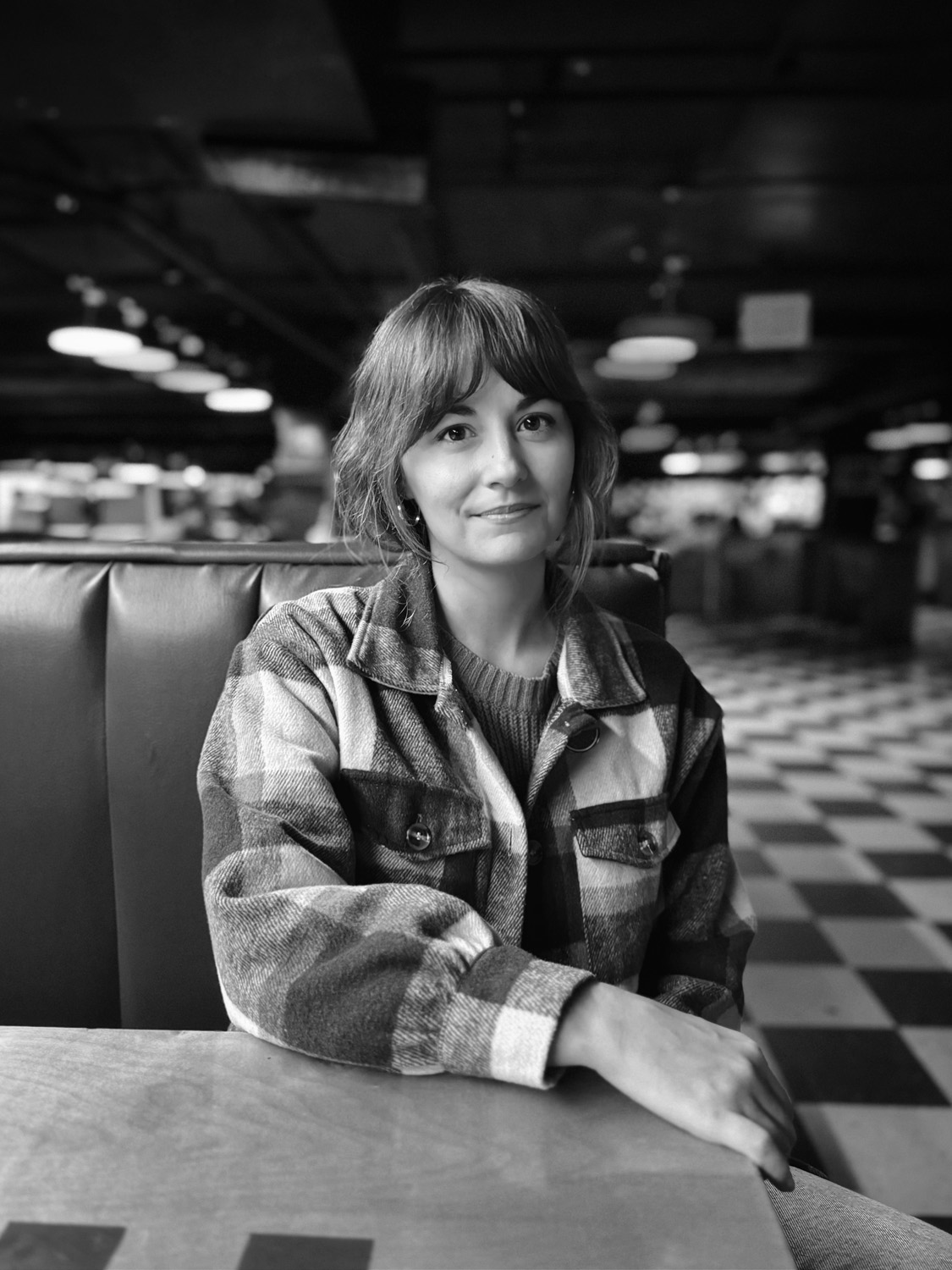
Lana Bastašić
Lana Bastašić is een in Joegoslavië geboren schrijfster. Ze publiceerde fictie, poëzie, essays en toneelstukken. Haar korte verhalen hebben talloze regionale prijzen in de Balkan gewonnen, waaronder de Ulaznica en de Zija Dizdarevic. Haar debuutroman, Vang de haas, won de Literatuurprijs van de Europese Unie en de Internationale Latisana-prijs in Italië. Het boek stond op de shortlist voor de Europese Literatuurprijs in Nederland en de longlist voor de Dublin International Literary Award. Het is in meer dan twintig talen vertaald. Ze publiceerde ook een verhalenbundel, Mliječni zubi (Melktanden), en een dagboek getiteld Crveni kofer (De rode koffer). Bastašić is een van de oprichters van de literaire school Escola Bloom in Barcelona.
Foto: Kirsten Tan